
The Spirit of Fascism in the Arts and the Prospects for Cultural Democracy: Testing a randomised jury model
This inter-university study hosted by Aberdeen’s Centre for Citizenship, Civil Society and the Rule of Law (CISRUL) draws from the work of the German-Jewish refugee sociologist Norbert Elias (1897-1990). Elias’s classic work, The Civilizing Process, shows the relationship between internal pacification and the externalisation of violence. This dynamic is reversible and rebounds on pacified territories giving way to a more prejudicial and violent politics of belonging.
Elias advocated ‘civilised controversy’ by which he meant more intensive public debate and deliberation. This coincides with our research premise that if broadening participation in the arts matters, it matters first and foremost at the level of public-funding decisions. Our study uses two methods to test deliberation in citizen juries randomly assembled from the general public to fund public-interest arts projects.
The first method is comparative: juries and more homogenous or specialist focus groups are presented with identical hypothetical applications for funding controversial arts projects which may communicate classical fascist ideas and the temptations of ‘aspiration fascism’ (Connolly 2017).
The second method is intensive: the randomly assembled juries have the additional task of selecting real commissioning themes in the public interest and agreeing on calls to artists for proposals.
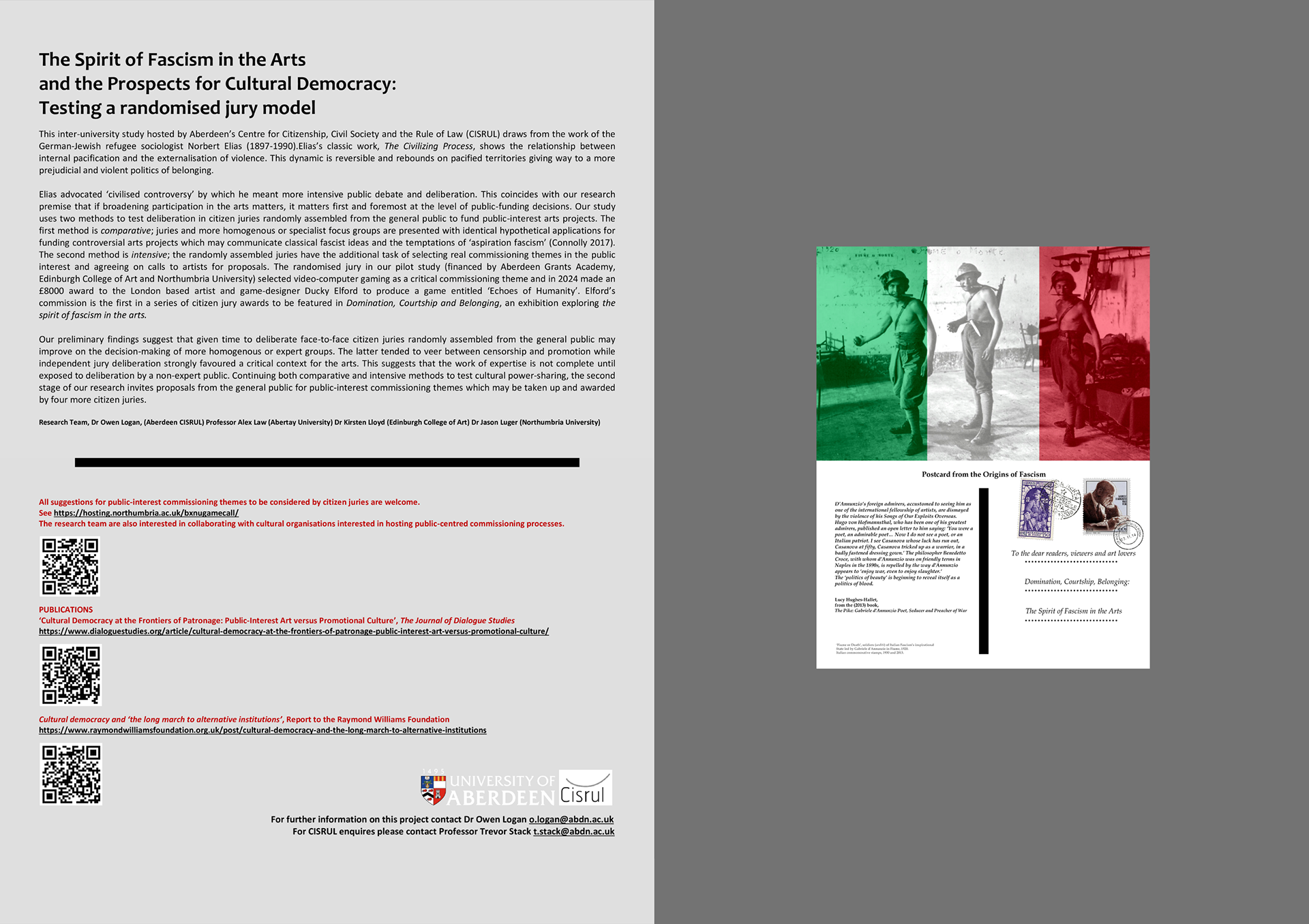
The randomised jury in our pilot study (financed by Aberdeen Grants Academy, Edinburgh College of Art and Northumbria University) selected video-computer gaming as a critical commissioning theme and in 2024 made an £8000 award to the London based artist and game-designer Ducky Elford to produce a game entitled ‘Echoes of Humanity’. Elford’s commission is the first in a series of citizen jury awards to be featured in Domination, Courtship and Belonging, an exhibition exploring the spirit of fascism in the arts.
Our preliminary findings suggest that given time to deliberate face-to-face citizen juries randomly assembled from the general public may improve on the decision-making of more homogenous or expert groups. The latter tended to veer between censorship and promotion while independent jury deliberation strongly favoured a critical context for the arts. This suggests that the work of expertise is not complete until exposed to deliberation by a non-expert public. Continuing both comparative and intensive methods to test cultural power-sharing, the second stage of our research invites proposals from the general public for public-interest commissioning themes which may be taken up and awarded by four more citizen juries.
Research Team: Dr Owen Logan (Aberdeen CISRUL) Professor Alex Law (Abertay University) Dr Kirsten Lloyd (Edinburgh College of Art) Dr Jason Luger (Northumbria University)
Calls and Participation
All suggestions for public-interest commissioning themes to be considered by citizen juries are welcome. See: https://hosting.northumbria.ac.uk/toxugamecall/ The research team are also interested in collaborating with cultural organisations interested in hosting public-centred commissioning processes.
Publications
‘Cultural Democracy at the Frontiers of Patronage: Public-Interest Art versus Promotional Culture’, The Journal of Dialogue Studies [Link provided via QR code]
‘Cultural democracy and the long march to alternative institutions’, Report to the Raymond Williams Foundation [Link provided via QR code]
Contact Information
University of Aberdeen | Cisrul For further information on this project contact Dr Owen Logan: o.logan@abdn.ac.uk For CISRUL enquires please contact Professor Trevor Stack: t.stack@abdn.ac.uk